Difference Between Checking and Savings Accounts: A Simple Beginner's Guide
Not sure whether you need a checking account, a savings account, or both? Here's the simple difference between them, how each one works, and how to tell which type of account you already have.
When I opened my first bank account at 18, the teller asked, "Checking or savings?" — and I froze. I had no idea there was a difference. I just wanted somewhere to keep my paycheck. If you've ever felt that same flicker of confusion, you're in the right place. The difference between a checking and a savings account is actually simple once someone explains it plainly, and knowing it can save you money and help you manage your cash a lot better.
Here's the short version, followed by everything you actually need to know.
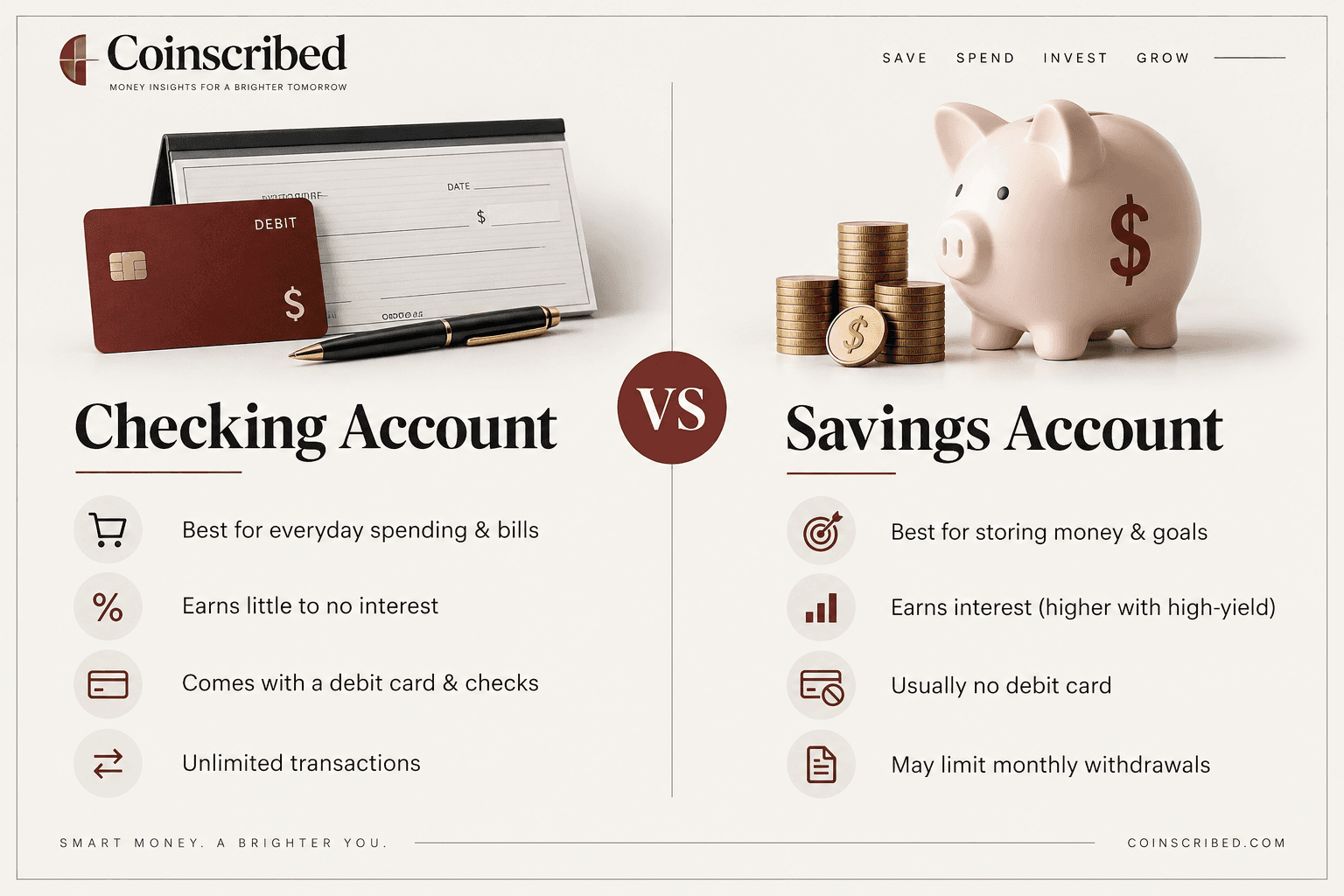
Quick answer: A checking account is built for everyday spending — paying bills, swiping your debit card, and withdrawing cash, with unlimited transactions and little to no interest. A savings account is built for storing money you don't need right away — it earns interest, but may limit how often you withdraw. Most people use both: checking for day-to-day money, savings for goals and emergencies.
Checking vs Savings Account: Side-by-Side
| Feature | Checking Account | Savings Account |
|---|---|---|
| Main purpose | Everyday spending and bills | Storing money and earning interest |
| Interest earned | Little to none | Yes — higher with high-yield accounts |
| Debit card | Yes | Usually no (ATM card only) |
| Writing checks | Yes | Rarely or no |
| Transaction limits | Unlimited | May be limited per month |
| Best for | Money you spend now | Money you're saving for later |
What Is a Checking Account?
A checking account is a bank account designed for money you use regularly. It's the account your paycheck typically lands in through direct deposit, and the one you spend from every day. You get a debit card, you can write checks, set up automatic bill payments, and withdraw cash at ATMs — usually with no limit on how many transactions you make.
The trade-off: checking accounts pay little or no interest. Their job isn't to grow your money — it's to move it. Think of your checking account as your wallet: a place money passes through on its way to bills, groceries, and everyday life.
What Is a Savings Account?
A savings account is designed to hold money you don't plan to touch right away — an emergency fund, a vacation, a down payment, or just a cash cushion. In return for leaving it alone, the bank pays you interest. With a regular savings account that interest is small, but with a high-yield savings account it can be meaningfully higher.
Savings accounts often limit how many withdrawals or transfers you can make in a month, and they usually don't come with a debit card or checks. That friction is intentional — it's there to help you leave the money alone so it can grow.
Key Differences Between Checking and Savings (For Beginners)
If you strip away the jargon, the difference comes down to four things:
- Purpose: Checking is for spending. Savings is for storing.
- Access: Checking gives you easy, unlimited access (debit card, checks). Savings makes access a little harder on purpose.
- Interest: Checking earns almost nothing. Savings earns interest — especially high-yield accounts.
- How often you use it: You touch checking daily; you touch savings occasionally.
Both are typically FDIC-insured up to $250,000 per depositor, per bank — so your money is protected the same way in either one.
Is a Debit Card Checking or Savings?
A debit card is almost always tied to your checking account. When you swipe it at a store or pull cash from an ATM, the money comes straight out of checking. That's exactly what checking is built for.
Savings accounts usually don't come with a debit card. Some banks give you an ATM-only card for savings, but it's meant for occasional withdrawals — not everyday tap-and-go spending. So if you're holding a card you use to buy coffee and groceries, it's connected to checking.
How Do I Know If My Account Is Checking or Savings?
If you're not sure which type you have, here are the quickest ways to tell:
- Check your app or statement. It almost always labels the account "Checking" or "Savings" right next to the balance.
- Do you have a debit card and write checks from it? That's checking.
- Does it earn noticeable interest and limit your withdrawals? That's savings.
- Is your paycheck deposited there and your bills paid from it? That's your checking account.
Still unsure? Call your bank or check the account details screen in your banking app — the account type is listed there.
How Much Should You Keep in Checking vs Savings?
A simple rule many people follow: keep about one to two months of expenses in checking to cover bills and daily spending, and keep the rest — especially your emergency fund — in savings where it earns interest.
Keeping too much in checking means you're leaving money on the table (it earns nothing). Keeping too little risks overdrafts. Your emergency fund (ideally three to six months of expenses) belongs in savings. You can estimate how fast that savings could grow with our savings calculator.
Can a Savings Account Have Checks or Direct Deposit?
Direct deposit: Yes — you can usually send your paycheck straight to savings, though most people route it to checking first and then transfer a set amount to savings.
Checks: Generally no. Traditional savings accounts don't come with a checkbook. If you need check-writing plus some interest, a money market account or an interest-bearing checking account is the closer fit.
How to Transfer Money Between Checking and Savings
Moving money between your own accounts is quick and free at most banks:
- Log into your banking app or website.
- Choose "Transfer" or "Move money."
- Pick the "from" account and the "to" account.
- Enter the amount and confirm.
Internal transfers between your own checking and savings are usually instant. A smart habit: set up an automatic transfer from checking to savings right after payday, so you save without thinking about it.
Do You Need Both a Checking and a Savings Account?
For most people, yes — and having both is the whole point. Checking handles the money flowing in and out of your life; savings protects the money you're setting aside. Together they keep your spending money and your goal money separate, which makes budgeting far easier.
If you share finances, a joint checking account plus a shared savings account is a common setup for couples — one for shared bills, one for shared goals. There's no rule that says you can only have one of each, either.
Frequently Asked Questions
Is my money safer in checking or savings?
Equally safe. Both are FDIC-insured (or NCUA-insured at credit unions) up to $250,000 per depositor, per institution.
Which best describes the purpose of checking and savings accounts?
A checking account is for money you spend regularly, while a savings account is for money you set aside to earn interest and reach financial goals.
Can I have a savings account without a checking account?
Yes. Many banks let you open a savings account on its own, though pairing it with checking makes transfers and everyday spending much easier.
Why does my savings account earn more interest than checking?
Because you agree to leave the money in place. Banks reward that stability with higher interest, especially on high-yield savings accounts.
Is a debit card checking or savings?
Checking. Debit cards are tied to your checking account so you can spend and withdraw from your everyday balance.
How do savings accounts work?
You deposit money, the bank pays you interest on the balance (quoted as an APY), and your money grows over time while staying accessible when you need it.
Can couples share a checking or savings account?
Yes. A joint account lets two people deposit, spend, and manage money together — common for shared bills (joint checking) and shared goals (joint savings).
Should I keep my emergency fund in checking or savings?
Savings. It earns interest and the slight friction to access it helps you avoid dipping into it for non-emergencies.
The Bottom Line
The difference between checking and savings is really about job description: checking is your spending account, savings is your storing-and-growing account. Use checking for the money moving through your life this month, and savings for the money you're protecting and growing for later. Set up an automatic transfer between them, and you've got a simple system that quietly does the work for you.
Get the latest finance & crypto news in your inbox
Market moves, calculators, and banking insights — a few times a week. No spam, unsubscribe anytime.