800 Credit Score: What It Gets You and How to Get There
An 800 credit score is exceptional, and nearly one in four Americans has one. Here's what it actually gets you on car loans, personal loans and mortgages, why the best rates often start near 780, and the habits that get you to 800 and keep you there.
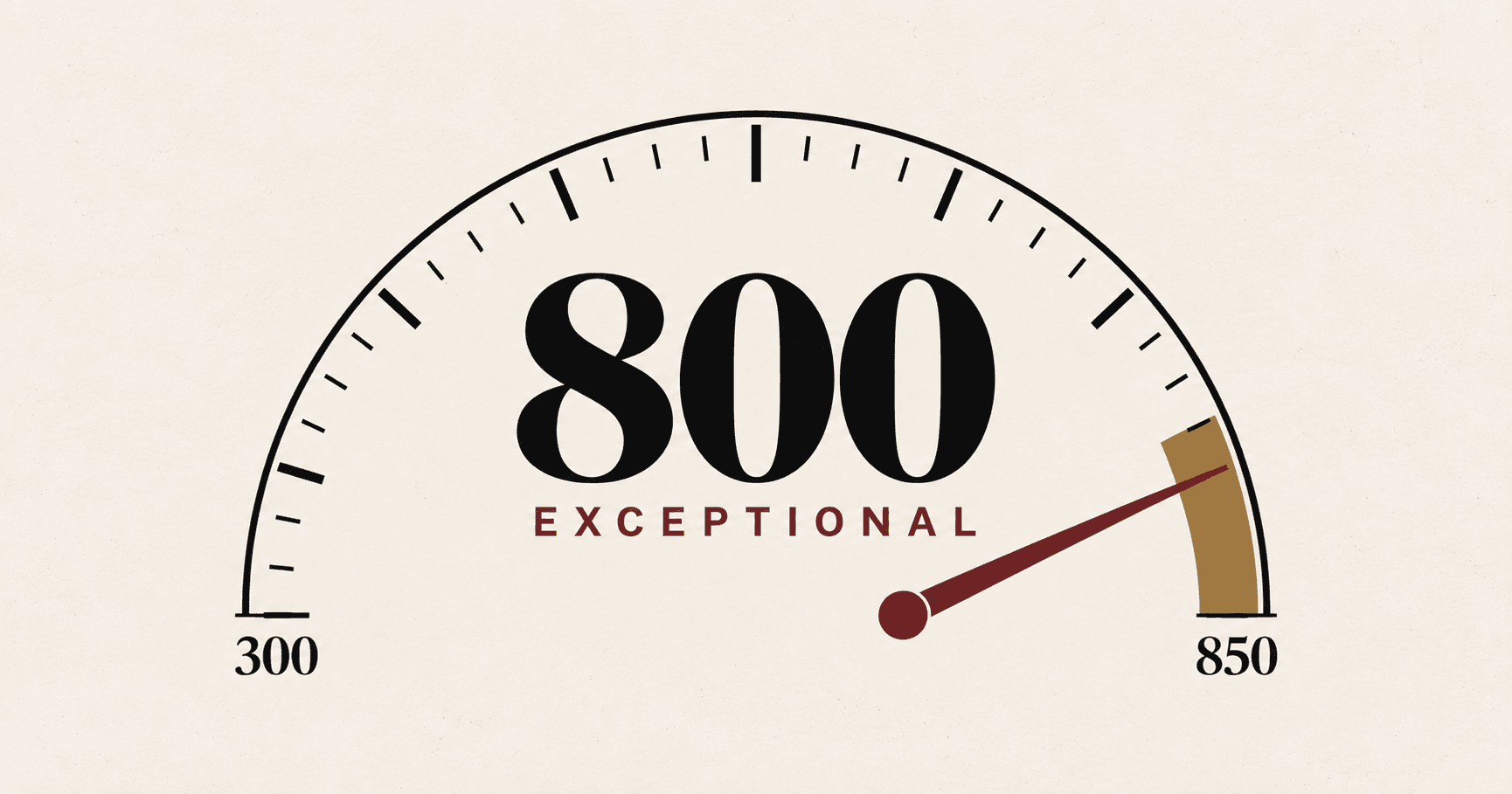
Short answer: An 800 credit score is exceptional. It sits in the top band of FICO's 300–850 scale, alongside 22.9% of US consumers as of June 2026, according to Experian. It qualifies you for most lenders' best offers, but those top tiers often start near 780, so the last 20 points mostly buy a cushion. Getting there takes two habits kept for years: no late payments, and card balances that report under 10% of your limits.
Maybe you just opened your banking app and the number finally read 800. Or maybe you've been parked at 765 for a year, paying everything on time, and you can't work out what's still missing.
Either way, you've probably noticed that most advice about an 800 credit score stops at "congratulations." That isn't much use. What you actually want to know is what the score buys, where the benefits stop, and what it takes to get there and stay there.
So here's the version with the numbers attached. One thing up front, because it changes how you should think about everything below: 800 is a great score, but for most loans it isn't the finish line. The finish line usually comes a little earlier.
What does an 800 credit score mean?
An 800 credit score means lenders see you as about as low-risk as borrowers get. So yes, 800 is a good credit score, and "good" undersells it. On FICO's scale, 800 to 850 is labeled exceptional. On VantageScore 3.0 and 4.0, the top band starts at 781 and is called excellent. Either way, an 800 credit rating puts you in the highest tier both models have.
Here's where a credit score of 800 sits against everyone else with a FICO® Score:
| FICO® Score range | Rating | Share of US consumers |
|---|---|---|
| 800–850 | Exceptional | 22.9% |
| 740–799 | Very good | 27.4% |
| 670–739 | Good | 19.8% |
| 580–669 | Fair | 15.1% |
| 300–579 | Poor | 14.9% |
Two things jump out. First, an 800 is exceptional but it isn't rare. It's closer to one person in four than one in a hundred. Second, the average FICO® Score is 713, so an 800 FICO® Score sits almost 90 points above the middle of the pack. For what every band means, see our guide to credit score ranges.
Who has an 800 credit score?
Age is the clearest pattern in the data, and it tells you a lot about how these scores get built.
| Generation | Average FICO® Score | Share with 800 or higher |
|---|---|---|
| Gen Z (under 30) | 678 | 4.3% |
| Millennials | 690 | 17.1% |
| Gen X | 710 | 24.3% |
| Baby boomers | 747 | 36.4% |
| Silent Generation | 760 | 37.1% |
Roughly one Gen Z consumer in 25 has a credit score above 800. Among baby boomers it's more than one in three. Habits play a part, but time plays a bigger one: the length of your credit history is the one scoring factor nobody can rush, and a boomer's file has had decades to age.
Geography shows up too. Minnesota leads the country, with 32.2% of consumers at 800 or higher, followed by Wisconsin (31.3%), New Hampshire (29.3%), Vermont (29.1%) and Washington (28.0%). At the other end sit Mississippi (13.7%), Louisiana (16.4%), Texas (16.9%), Oklahoma (17.1%) and Alabama (17.3%). And the group keeps growing: 19.5% of consumers had an 800-plus FICO® Score in 2016, according to Experian's analysis, against 22.9% now.
Related: Does paying off a credit card raise your score, and how fast?
What can you get with an 800 credit score?
In one line: the best offers lenders make on almost anything priced by risk. That's the real list of 800 credit score benefits, and here's what it looks like in rates, using Experian's latest auto loan data and its 2026 personal loan figures:
| Loan | Top tier (where an 800 lands) | Lower tier |
|---|---|---|
| New car loan, average APR | 4.41% (super prime, 781 and up) | 6.15% (prime, 661–780) |
| Used car loan, average APR | 6.29% (super prime) | 8.81% (prime) |
| Personal loan, median APR offered | 13% (exceptional, 800–850) | 19% (good, 670–739) |
| Conventional mortgage | Best credit-score pricing (780 and up) | Larger price adjustments below 780 |
In dollars: on a $40,000 new-car loan over 60 months, 4.41% works out to about $744 a month and roughly $4,645 in total interest. At the prime-tier average of 6.15%, it's about $776 a month and $6,566 in interest, so the top tier saves you around $1,900. Against the near-prime average of 9.71%, the gap grows to about $100 a month and $6,000 over the life of the loan. You can run your own numbers in our auto loan calculator.
A personal loan tells the same story. Borrow $10,000 for three years at 13% and you'll pay about $337 a month and $2,130 in interest. At 19%, it's about $367 a month and $3,196 in interest, roughly $1,070 more for the same money.
Put those side by side and the tier stops being a label and starts being a figure you could spend:
| What you borrow | Interest at the top tier | Interest one tier down | Extra you pay |
|---|---|---|---|
| $40,000 new car, 60 months | $4,645 at 4.41% | $6,566 at 6.15% | $1,921 |
| $40,000 new car, 60 months, against near prime | $4,645 at 4.41% | $10,651 at 9.71% | $6,006 |
| $10,000 personal loan, 36 months | $2,130 at 13% | $3,196 at 19% | $1,066 |
The car-loan row is the one worth sitting with. On a single $40,000 purchase, the distance between super prime and near prime is about $6,000 over five years, which is roughly 15% of the price of the car. The score is not a vanity metric at that point. It is a discount.
Rates aren't the only thing an 800 changes:
- Credit cards. Premium rewards cards and high limits are built for this tier. An 800 doesn't guarantee approval, because issuers still look at income and existing debt, but it takes your score off the list of reasons to say no.
- Insurance. In most states, auto and home insurers can price policies partly on a credit-based insurance score, which is built from the same credit report. A clean, low-balance file tends to help. California, Hawaii and Massachusetts are among the states that ban or restrict the practice.
- Renting and utilities. Landlords, utilities and phone carriers often check credit, and strong credit can mean a faster approval or no security deposit.
- Bargaining room. When you're the borrower every lender wants, asking for a rate match or a lower card APR is a real conversation, not a long shot.
What an 800 won't do is override the rest of your application. Experian makes the point in its own research: even an exceptional score doesn't guarantee approval if your income and other requirements don't line up.
Is an 800 credit score better than 780?
For pricing, usually not. This is the part most articles skip.
Conventional mortgages sold to Fannie Mae and Freddie Mac are priced on a grid of loan-level price adjustments, and the top credit-score bucket on that grid is 780 and above. A borrower at 780 and a borrower at 820 get the same credit-score pricing on those loans, as long as everything else matches. Experian's top auto tier begins at 781. And FICO itself notes that creditors usually set a cutoff and may give their best offers to anyone in the upper 700s or higher, rather than saving them for perfect scores.
So what do the points above 780 buy? A cushion. Scores move every month as balances report and inquiries post. For most people, a single new inquiry takes less than five points off a FICO® Score, according to myFICO. That's small, but it's enough to push a 782 under a 780 cutoff at exactly the wrong moment. At 815, the same inquiry doesn't matter.
My take: if you're sitting at 785 and about to apply for a mortgage, stop trying to squeeze out more points. Put that energy into getting quotes from three or four lenders inside the same two weeks. That's where the real money is.
Which 800 are you looking at?
The 800 in your app may not be the score a lender pulls. Many free apps show a VantageScore 3.0. Banks and card issuers often show FICO® Score 8. Mortgage lenders have traditionally used older "Classic" FICO versions, and in 2026 Fannie Mae and Freddie Mac opened the door to VantageScore 4.0 as well. Auto lenders often use FICO Auto Scores, which run on a different scale entirely. These numbers can differ, so don't panic if a lender's score comes back lower than the one on your phone.
What people with 800+ credit scores actually do
Experian compared consumers with 800-plus FICO® Scores to everyone else. The results are more interesting than "they have no debt," because they do have debt.
| Average | All consumers | 800+ FICO® Scores |
|---|---|---|
| FICO® Score | 713 | 823 |
| Number of credit cards | 3.7 | 4.6 |
| Credit card balance | $6,775 | $4,270 |
| Credit utilization | 29% | 7% |
| Accounts ever 30+ days late | 1.63 | 0.01 |
| Auto loan balance | $25,208 | $23,646 |
| Mortgage balance | $264,594 | $276,616 |
Three things stand out:
- They owe money. Their average mortgage balance is higher than the national average, and their car loans are about the same size. An 800 isn't a reward for being debt-free.
- Their cards aren't empty. They carry $4,270 on average but use just 7% of their limits, so there's a lot of unused credit behind those balances. They also hold nearly one more card than the typical consumer.
- They basically never pay late. The average 800-plus consumer has 0.01 accounts that were ever 30 or more days late. Put simply, almost nobody in this group has one.
That last row is the whole game. Balances can be fixed in a month. A late payment sits on your report for years.
How to get an 800 credit score
If you're wondering how to achieve an 800 credit score, there's no trick, which is good news or bad news depending on how patient you are. It comes down to a few habits held for long enough. Here they are, roughly in order of how much they matter.
1. Never miss a payment
Payment history is 35% of a FICO® Score, the biggest single factor. Set every account to autopay at least the minimum, then pay the rest by hand if you like. The autopay is a safety net, not a strategy.
If a due date slips past, pay right away. Lenders generally don't report a payment as late to the credit bureaus until it's 30 days past due. You may owe a late fee, but a payment made on day five usually never touches your credit report.
2. Keep your reported balances under 10%
Amounts owed make up 30% of your score, and credit utilization is the heart of it. The average 800-plus consumer uses 7% of their limits. Both your overall ratio and each card's ratio count, so one maxed-out card can hurt even when the total looks fine.
Top scorers do not just stay under 30% - they run far lower. See exactly how much of your credit you should use.
| Total credit limits | 10% of limits | 7% of limits |
|---|---|---|
| $10,000 | $1,000 | $700 |
| $25,000 | $2,500 | $1,750 |
| $50,000 | $5,000 | $3,500 |
The part most people miss is timing. Card issuers usually report your statement balance, not what you owe on the due date. Charge $3,000 a month on a $10,000 limit and pay it in full after the statement closes, and the bureaus still see 30%. Pay most of it off a few days before the statement date and they see something much smaller, with no change to your spending. If you're carrying balances you can't clear yet, our guide to paying off credit card debt and the credit card payoff calculator will show you the fastest route.
3. Ask for higher limits, not more cards
A higher limit lowers your utilization without adding a new account to your report. Many issuers let you request an increase online. Ask first whether the request triggers a hard inquiry, because some do and some don't. And it only works if the new limit doesn't turn into new spending.
4. Keep your oldest cards open
Length of credit history is 15% of your score. Closing an old card shrinks your available credit, which pushes utilization up right away, and it can shorten your history over time. If an old card has an annual fee, ask the issuer to switch it to a no-fee card instead. If it's already free, put one small recurring bill on it so it doesn't get closed for inactivity.
5. Apply rarely, and rate-shop fast
Hard inquiries stay on your report for two years but count toward FICO® Scores for only one, and a single inquiry usually costs less than five points. The real risk is a cluster of applications. When you shop for a mortgage, auto or student loan, FICO counts multiple inquiries as one if they fall within a short window: 45 days on newer FICO versions and 14 days on older ones. You won't know which version a lender uses, so keep your shopping inside 14 days.
6. Don't borrow just to improve your credit mix
Credit mix is only 10% of the score. In FICO's own simulation, a borrower at 793 who took out a $5,000 personal loan dropped to between 770 and 790. A card plus the loans you'd have anyway, like a car loan or a mortgage, is plenty.
7. Check your credit reports for errors
You can pull your Equifax, Experian and TransUnion reports free every week at AnnualCreditReport.com. Look for late payments you don't recognize, accounts that aren't yours and balances that never updated. Disputing a genuine error with the bureau that reports it is free, and removing a wrong negative mark can be the fastest score gain there is.
How long does it take to get an 800 credit score?
There's no official timeline, and anyone who promises one is guessing. What the data does show is that time does a lot of the work. Only 4.3% of Gen Z consumers have reached 800. And in FICO's 2023 profile of people with perfect 850 scores, the oldest account on the file averaged 30 years.
You don't need 30 years for an 800, though. What you need depends on what's holding your score down today:
| If your score is held back by | What fixes it | How fast |
|---|---|---|
| High card balances | Paying balances down before statements close | As soon as the lower balances report, often within a month or two |
| A recent late payment or collection | Time, plus a clean record from here on | Years. The impact fades as it ages, and it drops off after seven years |
| A young or thin credit file | Keeping accounts open and adding new ones slowly | Years. Only time lengthens a history |
| Errors on your report | Disputing them with the credit bureau | Usually within 30 days of filing, sometimes up to 45 |
If you're at 700 and wondering how to increase your credit score to 800, compare your file with the Experian table above. The typical consumer at 713 uses 29% of their limits and has more than one late payment somewhere in their history. The typical 800-plus consumer uses 7% and has none. Those are the two gaps, and the first one closes a lot faster than the second.
What can drop an 800 credit score?
A high score has further to fall, and it falls faster. FICO simulated how different moves would change the score of a borrower at 793 with 21 accounts, 19 years of history, 12% utilization and no late payments:
| What happens | Score afterward (starting at 793) |
|---|---|
| Pays revolving balances down by 25% | 795–815 |
| Takes out a $5,000 personal loan | 770–790 |
| Misses a payment by 30 days | 710–730 |
| Maxes out credit cards | 665–685 |
| Misses a payment by 90 days | 660–680 |
The same simulation gave a borrower at 607, who already had a recent late payment, a smaller drop for a new 30-day late: to 570–590. FICO's explanation is that the lower score had already priced in the risk. The clean file had more to lose.
So the better your score, the more one mistake costs. The cheapest protection is boring: autopay on every account and a balance alert on every card.
Can you have an 800 credit score with a late payment?
You can, but it's uncommon. Late payments can stay on your report for up to seven years, and their weight fades as they age, so an old, one-off late payment can sit alongside a very high score. Still, remember that 0.01 figure: among consumers with 800-plus scores, late payments are almost nonexistent. If you have a recent one on an otherwise spotless record, write to the lender and ask for a goodwill adjustment. Some will remove it, many won't, and it costs nothing to ask.
Is a 900 credit score possible?
Not on the scores most people see. Base FICO® Scores and current VantageScore models all top out at 850. The idea of a credit score of 900 comes from two other places:
- FICO's industry-specific scores. FICO Auto Scores and FICO Bankcard Scores, built for auto lenders and card issuers, run from 250 to 900. A 900 exists there, and the habits that earn a top base score push these toward the top as well.
- Older VantageScore versions. VantageScore 1.0 and 2.0 used a 501–990 range before the company moved to 300–850 with version 3.0.
So if you're wondering how to get a 900 credit score, the honest answer is that on the base scale you can't, and you don't need to. No lender saves its best rate for a number that doesn't exist on the score it pulls.
800 vs. 850: is a perfect score worth chasing?
Only 1.71% of consumers had a perfect 850 in June 2026, according to Experian. FICO's 2023 profile of that group is surprisingly relaxed: no late payments or collections and average revolving utilization of just 4.1%, but also an average of $13,000 in non-mortgage balances. About 10% had a hard inquiry in the previous year, and about a quarter had opened a new account.
In other words, even perfect-score people borrow, apply and carry balances. They just do it carefully, and they've been doing it for a long time. Experian's own view is that consumers with 800-plus scores qualify for the same terms as someone at 850, all else being equal.
So chase 850 if it's fun for you. Just don't mistake it for a financial goal. Once you're past 800, the payoff comes from how you use the credit, not from the last 50 points.
The bottom line
An 800 credit score puts you in the top tier alongside nearly a quarter of Americans, and it gets you the best rates on car loans, personal loans and mortgages. But the rate benefits usually start near 780, so treat everything above that as a buffer, not a prize. The route there is plain: never pay late, keep reported balances under 10%, leave your old accounts open and let time do the rest.
Our take: aim for 780, not 800. Every pricing tier that actually moves a rate begins there, so the last 20 points buy almost nothing on a rate sheet. What they do buy is room to be normal: one month with a high balance, or one new card, and you are still inside the best tier rather than just below its cutoff.
Which is why we would not chase 850 at all. Past 780 the goal stops being a higher number and becomes a steadier one, and the habits that hold a score steady are the same three every time. That is the honest reason this guide is short on tricks.
If you're just getting started, read what your credit score starts at. If a car is your next big purchase, here's what credit score you need to buy a car. And for quick definitions, our glossary covers credit score and credit utilization.
Frequently Asked Questions
- Is 800 a good credit score?
- Yes. On FICO's 300–850 scale, 800 to 850 is the exceptional range, and on VantageScore an 800 is excellent, since that model's top band starts at 781. About 22.9% of US consumers had a FICO Score of 800 or higher in June 2026, according to Experian.
- What percentage of people have a credit score over 800?
- About 22.9% of US consumers had a FICO Score of 800 or higher as of June 2026, according to Experian, up from 19.5% in 2016. Only 1.71% had a perfect 850.
- What can you get with an 800 credit score?
- The best offers on most credit. In Q2 2026, super prime borrowers averaged 4.41% on new car loans versus 6.15% for prime, and personal loan offers to exceptional-credit borrowers had a median APR of 13% versus 19% for good credit. Approval for premium credit cards gets easier too, though income still matters.
- Is an 800 credit score better than 780?
- Usually not on price. The top credit-score tier on Fannie Mae and Freddie Mac's mortgage pricing grid starts at 780, and Experian's top auto tier starts at 781. The extra points mostly give you a cushion, so a new inquiry or a high balance doesn't drop you below a lender's cutoff.
- How long does it take to get an 800 credit score?
- There's no set timeline. Lower card balances can lift your score as soon as they report, but length of history takes years. In Experian's June 2026 data, only 4.3% of Gen Z consumers, all under 30, had 800-plus scores, compared with 36.4% of baby boomers.
- Can you have an 800 credit score with a late payment?
- It's possible, especially once the late payment is several years old, but it's uncommon. Experian found consumers with 800-plus scores average 0.01 accounts ever 30 or more days late. Late payments can stay on your credit report for up to seven years.
- Is a 900 credit score possible?
- Not on base FICO Scores or current VantageScore models, which top out at 850. FICO's industry-specific scores for auto lenders and card issuers run from 250 to 900, and older VantageScore versions used a 501–990 range, which is where the idea of a 900 comes from.
- How can I raise my credit score 100 points?
- The biggest quick gains usually come from paying down cards that are near their limits: in a FICO simulation, maxing out cards cost a 793 score more than 100 points. Removing a genuine error from your report can also help fast. Late payments and collections only fade with time.
Sources
- Experian's analysis (experian.com)
- Experian's latest auto loan data (experian.com)
- loan-level price adjustments (singlefamily.fanniemae.com)
- FICO itself notes (myfico.com)
- FICO simulated (myfico.com)
Get new money guides and tools in your inbox
New guides, calculators and data studies when they publish. No spam, unsubscribe anytime.