What Does Your Credit Score Start At?
Your credit score doesn't start at zero - or at 300. With no credit history you have no score at all, and about one in ten US adults has a credit file that still can't be scored. Here's when your first score appears, where it lands, and how to build it.
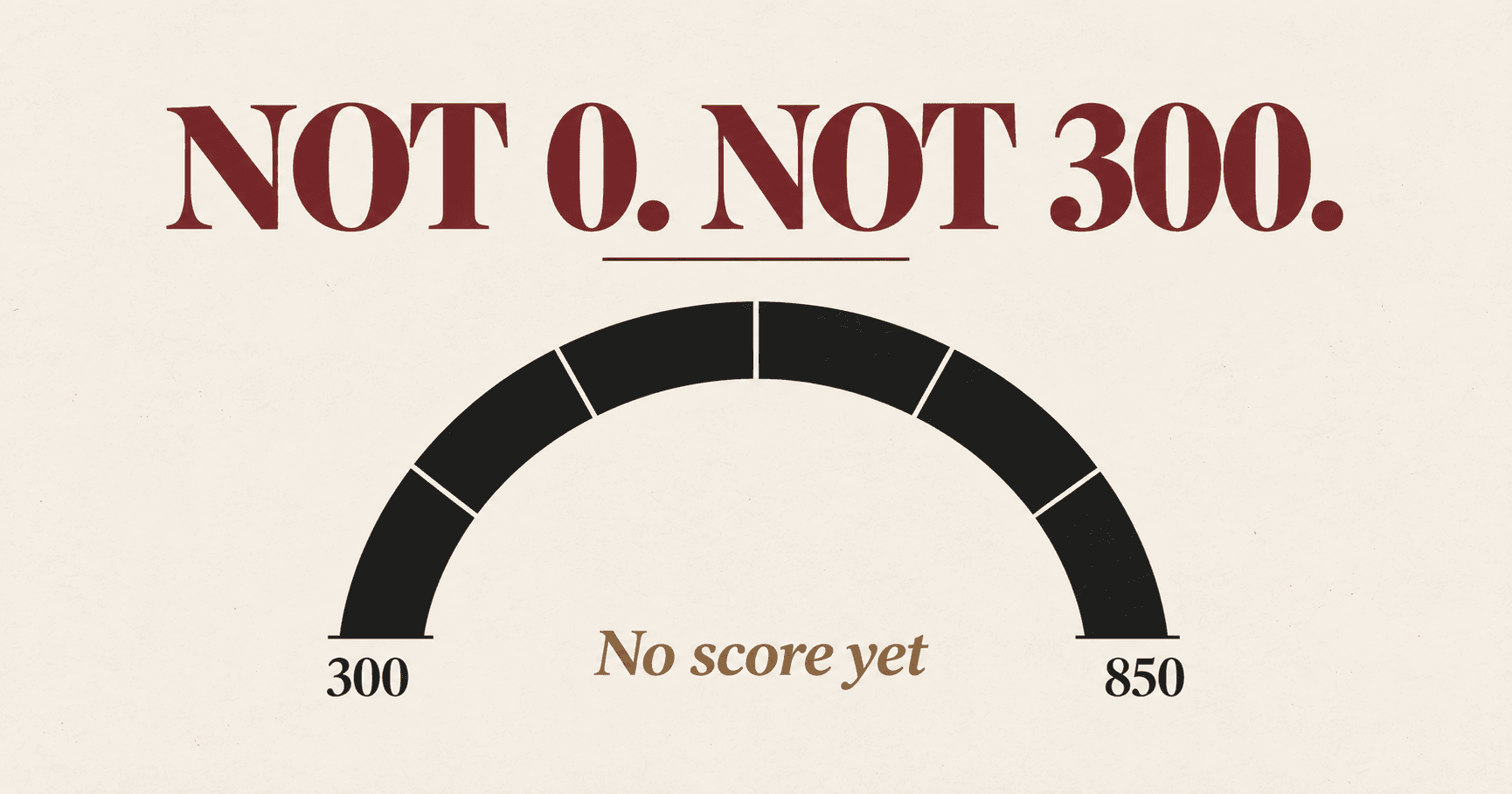
Short answer: Your credit score doesn't start at zero, and it doesn't start at 300. Until there's enough history in your credit report, you have no score at all. A FICO® Score usually appears once you have an account that's at least six months old and has reported in the last six months - and where that first number lands depends on how the account has been handled.
Picture the first week after your first credit card arrives. You open your banking app every morning expecting a number to appear, and there's nothing. No score, not even a bad one. It's easy to assume something's broken, or that you're sitting at zero.
You're not. You're in the most normal place in American credit: on file, but not yet scoreable. And you've got company. Federal data suggests roughly one adult in ten is in exactly that spot right now - more than three times as many as the people who have no credit file at all.
Here's what's actually going on, what your first score is likely to look like, and the quiet mistakes that keep new scores lower than they need to be.
Does your credit score start at zero?
No. A credit score isn't a balance that starts empty and fills up. It's a calculation - a scoring model reads your credit report and produces a three-digit number at the moment a lender, card issuer or app asks for one.
No data, no calculation. If your report has nothing on it, or not enough, you don't have a low score. You have no score. That distinction matters more than it sounds, because lenders treat "no score" very differently from "bad score." A missing score usually means a manual review or a starter product. A bad score means you've already shown them something they didn't like.
Does your credit score start at 300?
Also no - 300 is the floor of the scale, not the starting line. The base FICO® Score and VantageScore® models most lenders use run from 300 to 850, and brand-new credit users almost never land at either end:
- You won't start near 300 unless your first accounts go badly - missed payments, a maxed-out card, a bill that goes to collections.
- You won't start at 850 either, however careful you are, because length of history is part of every score and yours is measured in months.
For context, the average FICO® Score across all US consumers was 713 in 2025, according to Experian - and that average includes people with decades of history behind them. For what each band means, see credit score ranges explained.
Related: How much of your credit limit to use
"No score" isn't the same as "no credit report"
This is the part most explanations skip. There are two different ways to have no credit score, and they're not equally common.
| US adults, December 2020 | Share | People |
|---|---|---|
| No credit record at all ("credit invisible") | 2.7% | 7.0 million |
| A credit record, but not enough to generate a score | about 9.8% | roughly 25 million |
| A credit record that can be scored | 87.5% | 225.3 million |
Source: Consumer Financial Protection Bureau, June 2025 update to its credit-invisibles estimate. The middle row is our calculation from the CFPB's published shares.
The CFPB originally estimated in 2015 that 26 million Americans were credit invisible. In 2025 it corrected that figure, cutting the estimate roughly in half and finding almost as many extra people in the "has a file but no score" group. In plain terms: far more Americans are stuck with a thin or stale file than with no file at all - which is exactly the situation a new credit user is in.
When do you get your first credit score?
That depends on which scoring model is running the numbers. The two big ones have different minimum rules:
| Scoring model | What it needs before it will score you |
|---|---|
| FICO® Score | At least one account open six months or more, at least one account reported to a credit bureau in the past six months, and no deceased indicator on the report |
| VantageScore® | Can generate a score as soon as your report lists one credit account, even one that's less than six months old |
That gap explains a moment that confuses a lot of people: a free app shows you a score a month or two after your first card arrives, but a lender that pulls a FICO® Score says you don't have one yet. Both can be true at once. FICO® Scores are used by 90% of top lenders, according to Experian, so the six-month mark is the one to plan big applications around.
Your first 12 months, step by step
Here's how the first year typically plays out. Timing varies by lender and bureau, but the order rarely does.
| When | What typically happens | What to do |
|---|---|---|
| Month 0 | You open your first account - a secured card, an authorized-user spot or a credit-builder loan | Put one small recurring bill on it and turn on autopay |
| Months 1–2 | The first statement reports to the bureaus; apps that use VantageScore may show a first score | Pay the statement in full and hold off on other applications |
| Month 6 | The account turns six months old - usually when a FICO® Score can first be generated | Check your FICO® Score; many banks, card issuers and Experian show one free |
| Months 6–12 | Some issuers review secured cards for an upgrade or a higher limit after on-time payments | Ask about a limit increase only if you won't spend more because of it |
| Month 12 and beyond | Your history keeps aging, and every on-time month adds to it | Add new accounts slowly - one at a time, months apart |
What will my first credit score be?
There's no default starting number. Nobody is handed a 600 or a 700 on day one. Your first score is simply the model's read of whatever your first accounts show, and for a FICO® Score that read is weighted like this:
| FICO® Score factor | Weight | What it means when you're new |
|---|---|---|
| Payment history | 35% | Every on-time payment counts. On a file with one account, a single 30-day late payment carries a lot of weight. |
| Amounts owed | 30% | Mostly credit utilization - how much of your limit your statement shows you using. |
| Length of credit history | 15% | The one factor you can't speed up. A new file is short by definition. |
| Credit mix | 10% | A card plus an installment loan helps a little. Never borrow just for this. |
| New credit | 10% | Several applications in a short span can pull a young score down. |
Read that table from the top and the strategy writes itself. The two heaviest factors - paying on time and keeping balances low - are completely in your hands from the first month. The history factor isn't, which is why a new score can be solid but not stellar, and why patience does more work than any trick.
The utilization math on a starter card
New cards come with small limits, which makes utilization easy to blow without noticing. A $120 grocery run on a $300 limit is 40% utilization. The dollar amounts that keep you in safe territory are smaller than most people expect:
| Credit limit | Keep the statement balance under (30%) | Even better (10%) |
|---|---|---|
| $300 | $90 | $30 |
| $500 | $150 | $50 |
| $1,000 | $300 | $100 |
One detail changes everything here: card issuers usually report your statement balance, not what you owe on the due date. If you spend $200 on a $500 card and pay it off after the statement closes, the bureaus still see 40%. Pay most of it down a few days before the statement date and the number they see drops - without changing how much you actually spent.
How to build your first credit score
If you're starting from nothing, you need at least one account that reports to the bureaus. These are the usual on-ramps:
- A secured credit card. You put down a refundable deposit, which usually becomes your limit. For most people starting from scratch, this is the cleanest first step: it's your own account, your own history, and it reports every month.
- Authorized-user status. A family member adds you to their card, and after a month or two it can appear on your report along with their payment history. It works well when the cardholder pays on time and keeps balances low - and backfires when they don't.
- A credit-builder loan. Typically $300 to $1,000, held in a savings account while you make payments over six to 24 months. Check that the lender reports to all three bureaus; not all do.
- A store card, carefully. Easier to get, but interest rates tend to be high. Only worth it if you'll pay it in full every month.
Rent, utilities and phone bills usually don't appear on credit reports. Experian Boost can add eligible on-time payments to your Experian report, but it only affects scores built from Experian data, so treat it as a bonus rather than a foundation.
Mistakes that quietly hold a new score back
- Closing your first card. It's your oldest account. Close it and your history gets younger overnight. If it has an annual fee, ask about a no-fee version instead.
- Paying after the statement date. You never paid interest, but your reported utilization still looked high every single month.
- Applying for three cards in a month. Each application adds a hard inquiry, and on a thin file, a cluster of them stands out.
- Letting a small bill slide. A $40 store-card balance or an unpaid medical or phone bill can do far more damage to a new file than its size suggests.
- Going quiet. Pay off your only loan, stop using your only card, and after six months with nothing reporting, a FICO® model may treat your file as unscoreable again - even with a spotless record.
That last one surprises people most. The fix is simple: keep one no-fee card open, put one small predictable charge on it each month, and pay it in full.
How long does it take to get a good credit score?
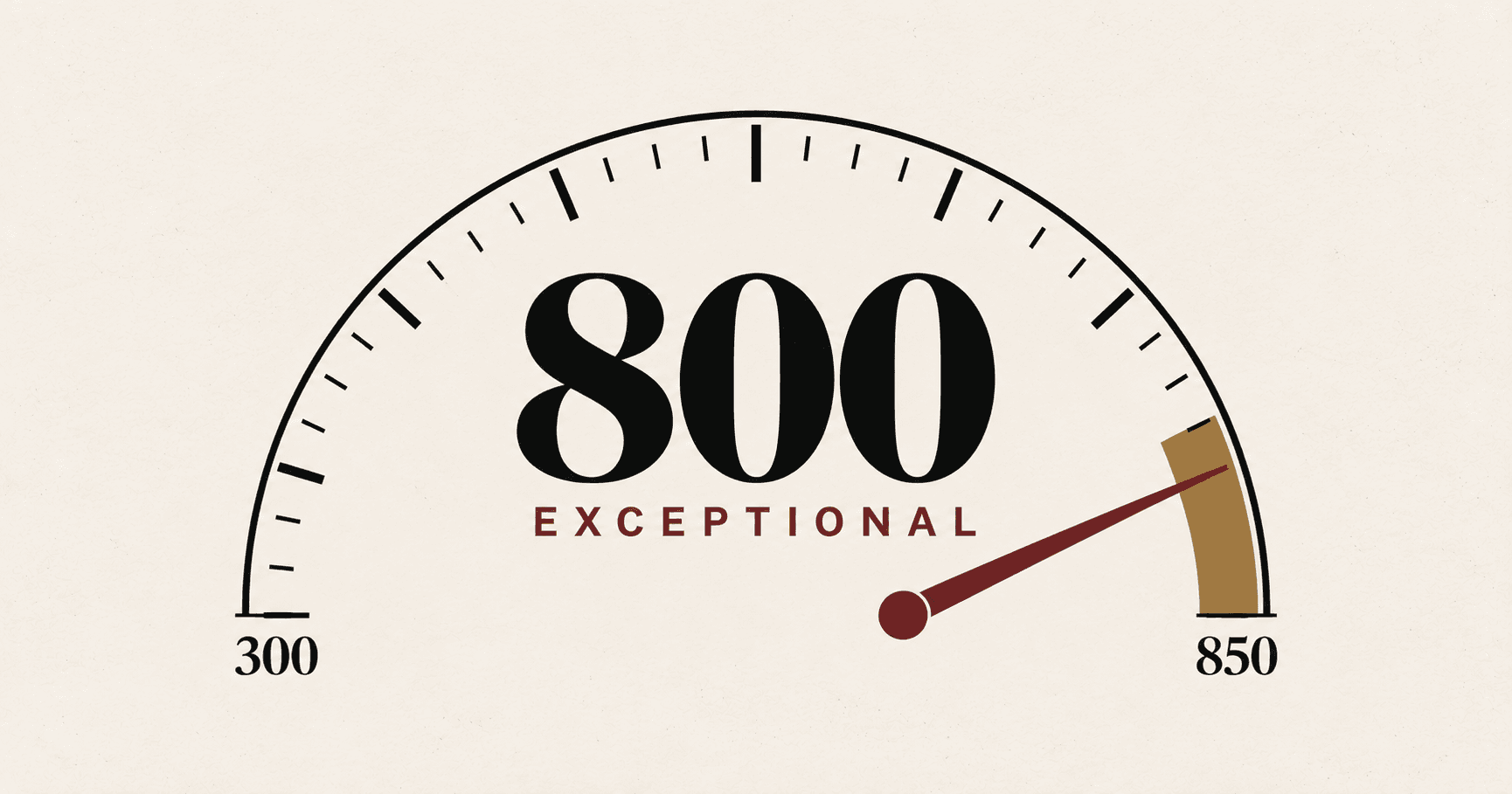
On the 300–850 FICO® scale, 670 to 739 is generally considered good, 740 to 799 very good, and 800 or higher exceptional. A first score built on one clean account can reach a respectable range within the first year, but the top bands take years, because length of history only counts in your favor as time passes.
Experian calls a file with fewer than five accounts "thin." That's normal at the start. Add accounts slowly, keep every one of them clean, and the file - and the score - steadies as it fills in.
If a car is your first big purchase, the score you build in these first months matters more than you'd think. Here's what credit score you need to buy a car and how much the rate changes between tiers.
Related: What an 800 credit score gets you
The bottom line
Nobody starts at zero, and nobody starts at 300. You start with no score, and your first accounts write your first number. Give the model six months of on-time payments and low statement balances, avoid the quiet mistakes, and the score that shows up will be one worth building on.
New to the terms? Our glossary defines credit score and credit utilization in a sentence each.
Frequently Asked Questions
- What does your credit score start at?
- It doesn't start at a number. With no credit history you have no score at all. Your first score is calculated from your first accounts and usually lands somewhere between 300 and 850 rather than at either end.
- Does everyone start with a credit score of 0?
- A: No. Zero isn't on the scale - the base FICO and VantageScore models run from 300 to 850. With little or no history you are unscored, not at zero. CFPB figures imply about one in ten US adults has a credit record that can't yet be scored.
- Do you start with a credit score of 300?
- Rarely. 300 is the lowest possible base score, and you would only be near it with serious problems such as missed payments or collections - not simply because you are new to credit.
- How long does it take to get a credit score?
- For a FICO Score, usually about six months: you need an account at least six months old and one reported to a credit bureau in the past six months. VantageScore can score you sooner, sometimes as soon as one account appears on your report.
- What is a good credit score to start with?
- There's no set starting score. A good target is 670 or higher, the good range on FICO's 300–850 scale. Paying on time and keeping statement balances low are the fastest ways to get there.
- Why don't I have a credit score?
- Usually because there are no accounts on your credit report, your accounts are less than six months old (for FICO), or nothing has been reported in the last six months. A secured card or becoming an authorized user can fix that.
- Can I build credit without a credit card?
- Yes. A credit-builder loan - typically $300 to $1,000 repaid over six to 24 months - or any installment loan paid on time builds history, as long as the lender reports to the credit bureaus.
- Does checking my own credit score lower it?
- No. Checking your own score is a soft inquiry and has no effect on it. Only hard inquiries, which happen when you apply for credit, can lower your score.
Sources
- myFICO: What are the minimum requirements for a FICO Score? (myfico.com)
- CFPB: Technical correction and update to the credit invisibles estimate (June 2025) (files.consumerfinance.gov)
- CFPB: How do I get a free copy of my credit reports? (consumerfinance.gov)
Get new money guides and tools in your inbox
New guides, calculators and data studies when they publish. No spam, unsubscribe anytime.